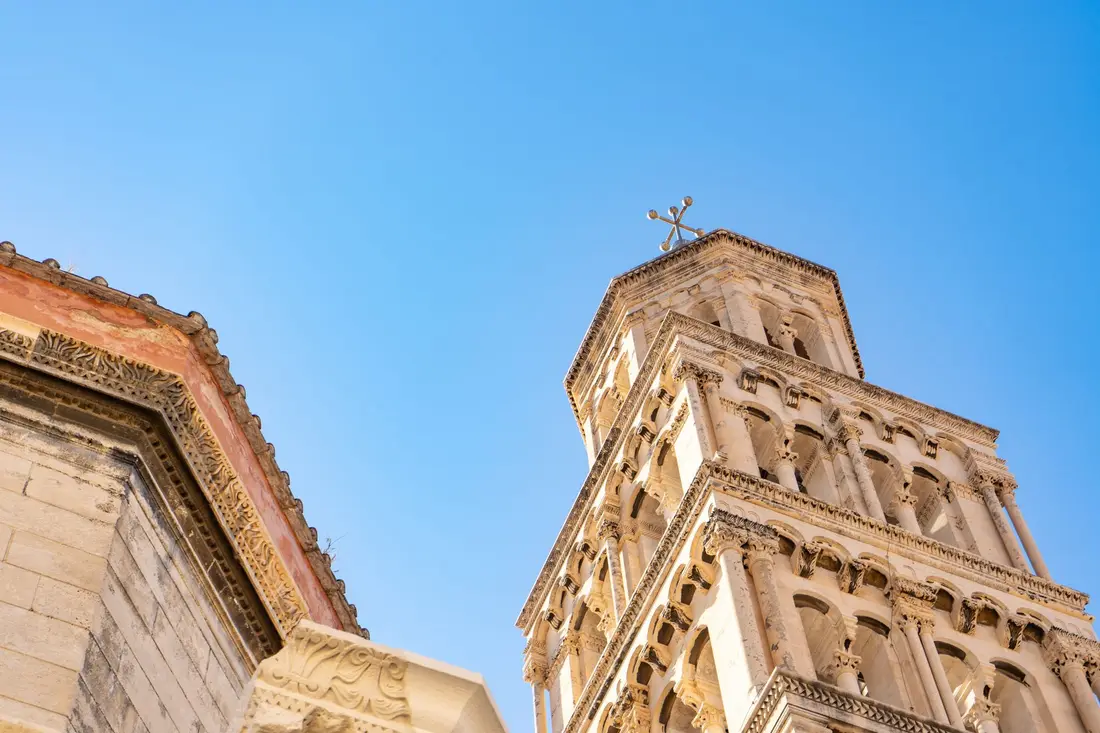
Split's old town is built inside the 1,700-year-old Diocletian's Palace, so you drink coffee between Roman columns and sleep in apartments set into the emperor's walls. Climb the cathedral bell tower for the harbor view, walk the Riva promenade, and hike or bike Marjan hill to reach pine-shaded beaches like Kasjuni. It is livelier and cheaper than Dubrovnik and the best ferry hub for Hvar and Brac.
3-day Split itinerary
- Day 1: Diocletian's Palace and the Peristyle, climb the bell tower of St. Domnius Cathedral, explore the substructures, evening stroll on the Riva
- Day 2: Morning at the Green Market and Varos lanes, hike up Marjan hill to the viewpoints, afternoon swim at Kasjuni or Bene beach
- Day 3: Half-day trip to Klis Fortress and the Salona Roman ruins, back for a swim at Bacvice and dinner in Varos
Where to stay: neighborhoods that make sense
- Old Town (Palace)inside and around Diocletian's Palace, unbeatable atmosphere but noisy on summer nights and hard for luggage
- Varosstone lanes just west of the center at the foot of Marjan, quiet, local and 5 minutes from everything
- Bacviceby the sandy city beach east of the port, good for nightlife and budget stays near the bus and ferry terminals
- Mejeresidential slopes below Marjan near the Mestrovic Gallery, calm and green, a 20 minute walk to the center
What to eat in Split
- Grilled fish with blitva (chard and potatoes)the standard Dalmatian dinner, about 18-25 EUR in a konoba
- Pasticada with gnocchibeef slow-braised in wine and prunes, Split's Sunday dish, around 15-18 EUR
- Soparnikthin chard-filled pie from the Poljica region sold by the slice, about 3-4 EUR
- Cevapi in flatbreadgrilled meat rolls from a fast-food grill, filling for 6-8 EUR
- Marenda (workers' lunch)fixed early-lunch menus in local konobas, a full plate for 8-10 EUR before 1pm
Mistakes most first-timers make
- Treating Split as only a transit stop to the islandsthe palace, Marjan and Klis deserve two full days
- Buying long-distance ferry tickets on the dock in July-August - Jadrolinija and Krilo catamarans to Hvar sell out, book a day or two ahead
- Eating at restaurants with photo menus on the Rivawalk 5 minutes into Varos for better food at 30 percent less
- Renting a car for day trips you can do by busTrogir, Klis and Omis all have cheap frequent buses and parking in Split is a nightmare
Worth leaving the city for
- Trogir (30 minutes by bus or boat)a tiny UNESCO island town with a superb Romanesque cathedral, easy half day
- Hvar Town (1 hour by fast catamaran)Venetian squares, the Spanish fortress and swimming off the Pakleni islands, about 15-22 EUR each way
- Krka National Park (1.5 hours by bus)boardwalk trails over a chain of waterfalls, go early to beat tour groups
Getting around
The airport bus to the main terminal by the port takes 30-40 minutes and costs about 8 EUR, a taxi or Uber is about 35-40 EUR. The center is fully walkable, and city buses (for Meje or Znjan) cost about 1.60-2 EUR per ride.
Why this plan won't send you to a closed café
Almawander is an AI travel planner that remembers you across trips - it learns your pace, budget, diet and taste, checks places are still open, and bakes in your passport's visa rules.